Home / USA News / Markets and Technology
U.S. FINANCE · WALL STREET · ARTIFICIAL INTELLIGENCE · NOVEMBER 21, 2026Wall Street Enters Correction as AI Selloff Pushes Nasdaq Into the Red for 2026
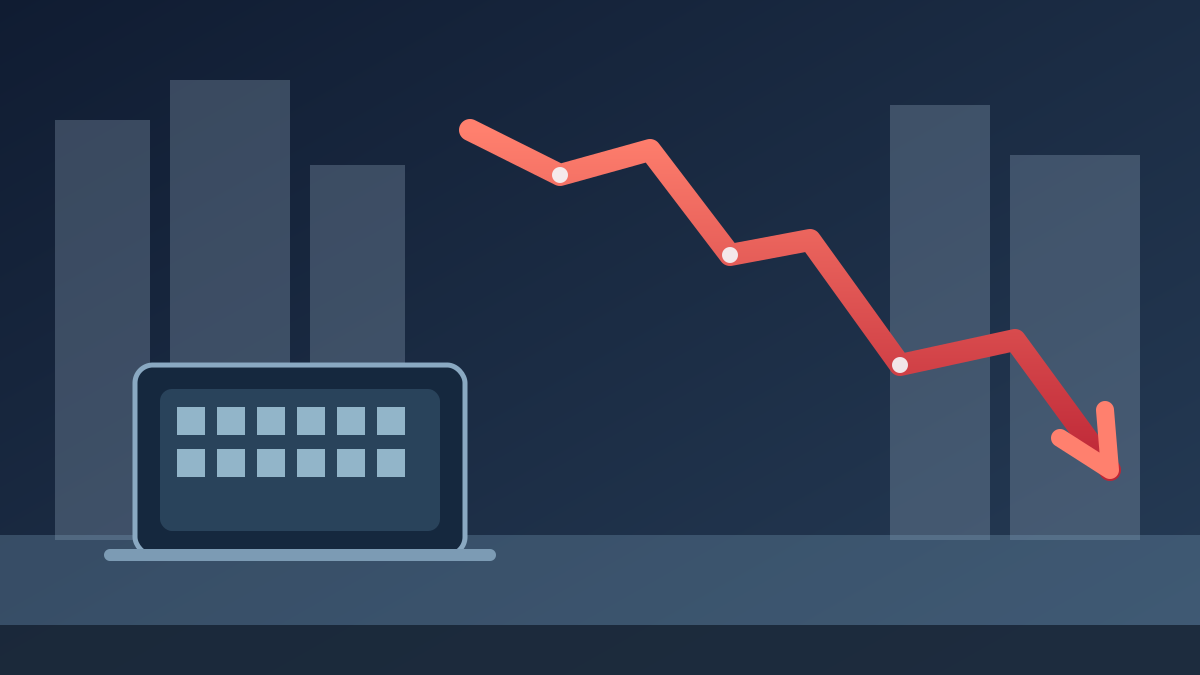
A technology-led sell-off drove the S&P 500 down 3.7% on Friday and pushed it more than 10% below its October record, the market definition of a correction. The Nasdaq fell 5.3% and turned negative for the year as investors reassessed the cost and expected returns of the artificial-intelligence buildout.
NEW YORK, November 21, 2026 — U.S. stocks ended the week with a sharp technology-led decline as investors sold semiconductor and artificial-intelligence shares, turning a sector pullback into a broader market correction. The S&P 500 dropped 265.44 points, or 3.7%, to 6,910.39 on Friday. It is now more than 10% below its October 6 record close, meeting the commonly used definition of a correction.
The Nasdaq Composite fell 1,261.47 points, or 5.3%, to 22,617.73, leaving the technology-heavy index down 2.7% for 2026. The Dow Jones Industrial Average, which has less exposure to technology stocks, declined 949.73 points, or 1.9%, to 48,147.33. The Russell 2000 fell 2.8% to 2,581.79.
Friday's losses capped the market's worst week in more than 18 months
The weekly decline was broad as well as deep. The S&P 500 lost 8.6% for the week, its worst weekly performance since April 2025. The Nasdaq fell 10%, the Dow lost 8%, and the Russell 2000 dropped 7.5%. The S&P 500 also recorded a seven-session losing streak, its longest since the early months of the COVID-19 pandemic in 2020, according to the Associated Press.
For the year, the picture is uneven rather than uniformly negative. The S&P 500 remained up 0.9% through Friday's close, the Dow was up 0.2%, and the Russell 2000 was up 4%. The Nasdaq was the major index that had moved below its year-end 2025 level, down 2.7%.
Chipmakers and AI-linked companies led the retreat
Semiconductor shares bore some of the heaviest losses. Nvidia fell 14% on Friday, while Advanced Micro Devices dropped 13.3%, Micron Technology slid 13.9%, and Broadcom lost 12.2%. The PHLX Semiconductor Index fell 10.7%. The selling also reached companies tied to data-center construction and power demand, including optical-products maker Corning and energy provider Bloom Energy.
Anthropic, whose public offering had drawn enormous attention a day earlier, fell 8.5% to $88.91. That was below its brief first-day high of $115.10 but remained above its $83 offering price. A sharp first-week move is not unusual for a newly listed company, but the decline showed how quickly sentiment toward even a high-profile AI business can change when the broader sector is under pressure.
Investors are questioning the cost of the AI buildout
The sell-off reflects a growing debate about whether the revenue expected from artificial-intelligence products will justify the enormous spending planned for chips, data centers, power, cooling and networking. Companies can continue to report strong demand for AI computing while investors become less willing to pay any price for future growth. Those are not contradictory signals: demand can be real, but valuations can still be too optimistic.
Political uncertainty has added another layer. Candidates who supported limits on data-center construction made gains in the November midterm elections, according to AP's market coverage. That does not mean new restrictions are certain, but it adds questions about local permitting, electricity demand and the speed at which new facilities can be built.
Investors are also weighing inflation and interest-rate risks. Higher borrowing costs reduce the present value of future earnings and make capital-intensive projects more expensive to finance. When expectations for long-term growth are already embedded in stock prices, even a modest change in interest-rate assumptions can produce large moves in high-valuation shares.
Bonds offered some shelter, but the move was not a market-wide panic
Government bonds rallied as investors sought safer assets. The yield on the 10-year U.S. Treasury note fell to 4.93% from 5.04% late Thursday. Brent crude rose 0.6% to $92.57 a barrel amid continuing tensions linked to the U.S. war with Iran and risks around the Strait of Hormuz.
The decline in Treasury yields suggests investors were seeking protection, but one volatile stock session does not by itself establish a credit crisis or a recession. Consumer sentiment also improved in the University of Michigan's latest reading, according to AP, showing that market prices and household confidence can move in different directions.
What a correction does — and does not — mean
A correction is generally defined as a decline of at least 10% from a recent high. It is a description of market performance, not a forecast that prices must fall another 10% or that the economy is already contracting. Corrections can occur during expansions as investors reassess earnings, valuations or risk.
For retirement savers and long-term investors, the key distinction is between a change in market price and a change in the underlying financial plan. Short-term trading decisions based on a single week can lock in losses, while diversified portfolios can still be exposed to concentration risk if a small group of large technology companies has become an outsized share of the market. Investors should assess their own time horizon, liquidity needs and risk tolerance rather than treating an index move as individualized financial advice.
What Wall Street will watch next
The next test is whether the decline remains concentrated in expensive AI-linked stocks or spreads into other sectors, corporate credit and consumer-facing businesses. Investors will scrutinize upcoming earnings for evidence that AI spending is translating into measurable revenue and productivity gains. They will also watch inflation data, Treasury yields and Federal Reserve commentary for clues about the cost of capital.
For now, the data show a steep repricing of technology risk, not proof that the AI industry has stopped growing. The market is asking a narrower question: how much future growth is already reflected in today's share prices, and how much spending can companies sustain before returns become visible?
Frequently asked questions
Is the S&P 500 officially in a correction?
Yes. Friday's close left the index more than 10% below its October 6 record, which meets the standard market definition of a correction.
Does a correction mean a recession is coming?
No. A correction describes a decline in stock prices. Recessions are determined from broader economic activity, including output, employment, income and spending.
Why did the Nasdaq fall more than the Dow?
The Nasdaq has greater exposure to technology and growth companies, including semiconductor and AI-related firms that were among Friday's biggest losers.
- Associated Press: S&P 500 sinks 3.7% and Nasdaq goes negative for the year
- Associated Press: How major U.S. stock indexes fared Friday, Nov. 20
Editorial note: This report distinguishes published agency figures, court actions and attributed statements from analysis. Figures and legal status are current to the publication time shown above; later agency or court updates may change the picture.
Related coverage: Latest U.S. news · Business and finance news