U.S. Equity Funds Lose $30.57 Billion in a Week as AI Spending Doubts Hit Tech Stocks
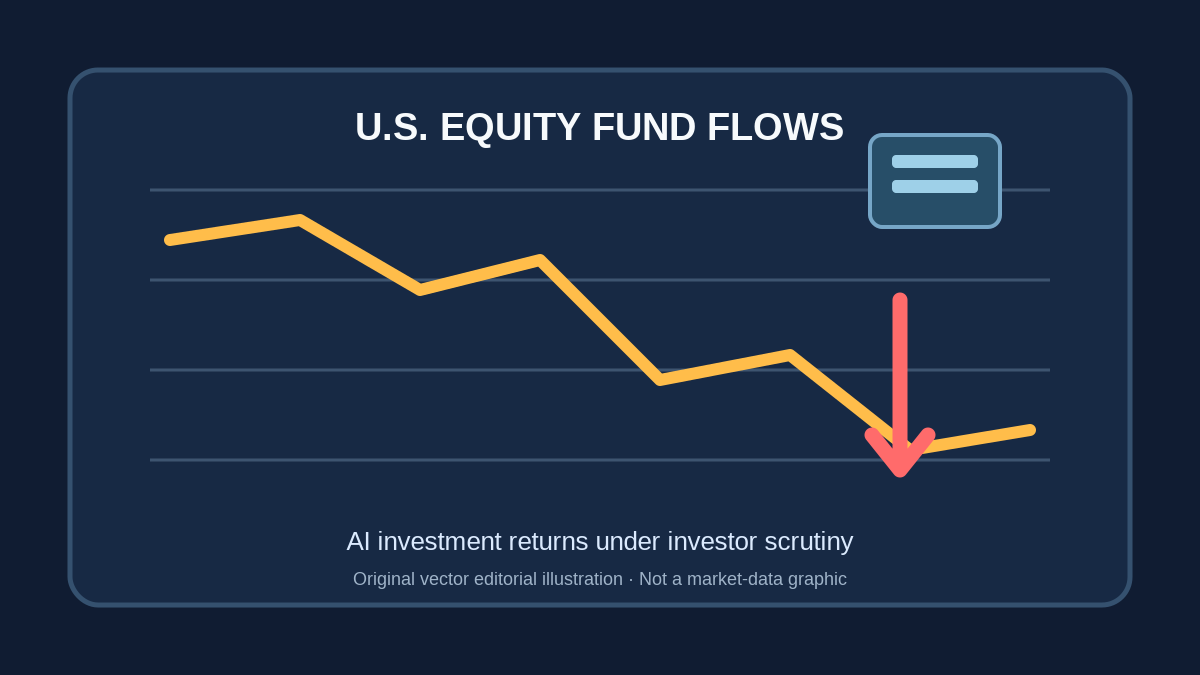
U.S. equity funds recorded $30.57 billion in net outflows in the week to November 25, the largest withdrawal since September 9, as investors questioned AI investment returns.
NEW YORK, November 27, 2026 — U.S. equity funds recorded their largest weekly net withdrawals in nearly three months as investors reassessed the cost of the artificial-intelligence buildout and questioned how quickly spending on data centres and models can translate into profits.
Investors pulled a net $30.57 billion from U.S. equity funds in the week through November 25, according to LSEG Lipper data cited by Reuters. It was the biggest weekly withdrawal since September 9. The figures cover the reporting week that ended before Friday’s U.S. trading session; they are not a count of every stock sale by every investor.
Technology funds led the withdrawals
U.S. equity sector funds recorded $12.41 billion in net outflows. Technology funds accounted for $9.27 billion, followed by healthcare funds with $2.36 billion and industrial funds with $2.26 billion. Multi-cap, large-cap, mid-cap and small-cap funds also recorded net withdrawals, showing that selling was not confined to a handful of technology names.
Bond-fund outflows eased to $649 million from $5.59 billion the previous week. Money-market funds, however, recorded a third consecutive weekly withdrawal, losing $18.15 billion. Those figures describe flows into and out of fund products; they do not by themselves establish where all investors moved their money.
Why AI investment is under scrutiny
The debate is increasingly about returns on the large amounts being committed to computing infrastructure. Companies are spending on advanced chips, data centres, electricity capacity and model development. Investors want evidence that future software and application revenue can cover those costs, including financing, depreciation and ongoing operating expenses.
Reuters cited a note from UBS Global Wealth Management estimating that revenue from AI models and applications would need to grow at least 750% over the next four years for the industry to earn an adequate return on cumulative investment. That is an analyst estimate about the scale of revenue growth required under UBS’s assumptions, not a guaranteed outcome or a universal industry threshold.
The same UBS note maintained a neutral view on U.S. and global equities. The fund-flow data suggest that some investors were reducing exposure while they reassessed valuations and the timing of returns, but flows alone cannot explain every portfolio decision.
What the figures do — and do not — say about the market
A weekly outflow is not the same as a forecast that share prices must fall. Funds can experience withdrawals while indexes rise, and a single week does not establish a long-term trend. The data also cover a defined group of funds and a specific reporting window, rather than every U.S. household, pension plan or direct brokerage account.
Reuters separately reported that global markets were rebounding on Friday after a difficult month for technology shares. That market snapshot followed the Thanksgiving holiday closure and does not change the LSEG Lipper figures for the week ended November 25.
What investors will watch next
- Whether large technology companies can show that AI-related revenue is growing alongside capital spending.
- How companies describe data-centre costs, power availability and expected returns in upcoming earnings reports.
- Whether fund flows stabilise after the recent withdrawals.
- How Federal Reserve commentary and incoming inflation data affect the cost of financing long-term investment.
The central question is not whether artificial intelligence will be used, but whether the cash flows generated by the technology will justify the pace and scale of investment. The latest fund data show that investors are demanding clearer evidence before treating the sector’s spending plans as a reliable path to earnings growth.
- Reuters: U.S. equity funds post biggest outflows in 11 weeks as tech rout weighs (November 27, 2026)
- Reuters: Global markets rebound as investors reassess AI-related valuations (November 27, 2026)
Editorial note: This report distinguishes reported data, official releases and analyst opinion. Market-flow figures are attributed to the source data provider; political allegations are attributed and are not presented as established fact.
Related coverage: Recent U.S. AI-stock sell-off coverage · Latest U.S. news