Wall Street Selloffs Can Trigger a Dollar Bounce as Overseas Investors Reset FX Hedges
Citi says foreign investors’ currency-hedge adjustments can create dollar buying after U.S. stock declines, helping explain why the currency sometimes rises even when risk sentiment is weak.
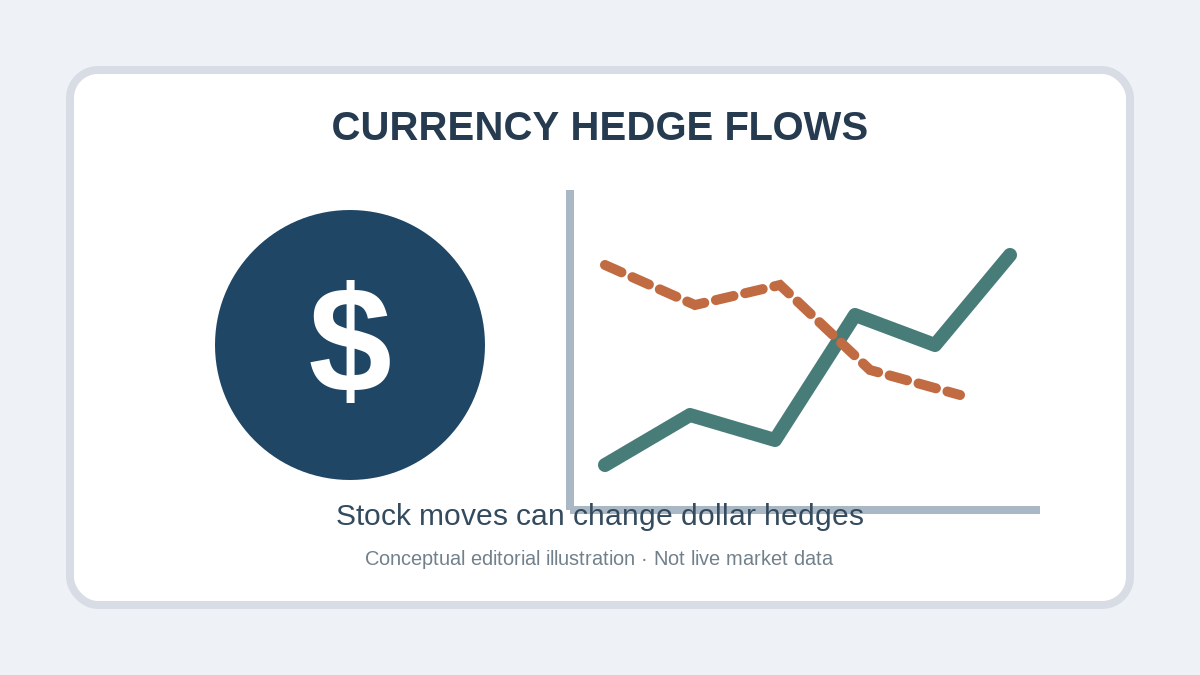
NEW YORK, November 27, 2026 — A falling U.S. stock market does not always push the dollar lower. In some sessions, overseas investors’ currency hedges can create the opposite effect: when U.S. shares fall, portfolio managers may buy dollars to reduce an existing hedge position.
That mechanism is one explanation offered by Citigroup for the dollar’s unusual moves after recent Wall Street selloffs. Reuters reported Friday that Citi observed net dollar buying by its global real-money clients on November 20 and November 23, following losses in U.S. equities on prior days. After stocks rebounded on November 24, those clients turned to net dollar selling.
How a stock-market hedge can create dollar demand
A foreign investor who owns U.S. shares faces two sources of return: the performance of the shares and the movement of the dollar against the investor’s home currency. If the dollar weakens, the value of the U.S. investment can fall when converted back into euros, yen or another currency, even if the shares themselves are unchanged.
Some investors use currency forwards to reduce that risk. A common hedge involves selling dollars forward against the investor’s home currency. The size of the hedge is often linked to the value of the underlying U.S. stock portfolio.
When U.S. shares fall, the dollar value of the portfolio also falls. If the investor leaves the old hedge untouched, the hedge may become larger than the new exposure. The manager can respond by buying back some dollars or reducing the short-dollar forward position. That adjustment creates dollar-buying demand in the currency market.
The process can reverse when equities rise. A larger U.S. stock portfolio may require a larger hedge, which can lead some investors to sell more dollars forward. The timing and size of the flows depend on each manager’s rules, hedge ratio and tolerance for currency risk.
Why the flows matter more when foreign holdings are large
Foreign investors held about $25.2 trillion in U.S. equities at market value in September 2026, according to the Federal Reserve Bank of St. Louis’ FRED series, which is sourced from Treasury International Capital data and the Federal Reserve system. A large overseas ownership base means even modest changes in hedge ratios can translate into sizeable currency transactions.
That figure measures the market value of foreign holdings; it is not a measure of money newly invested during September, and it does not mean every foreign investor hedges. Some funds leave currency exposure unhedged, while others use different instruments or rebalance only at set intervals.
Why investors are adjusting hedges more quickly
Portfolio managers have traditionally reviewed currency hedges around month-end. Reuters quoted Citi and Russell Investments analysts who said some investors now make adjustments more dynamically when equity moves push their hedge ratios beyond preset limits.
Faster rebalancing can make currency markets respond more quickly to sharp stock moves. It can also create a timing contest: hedge funds may try to trade ahead of predictable month-end flows, encouraging some large investors to adjust earlier rather than wait until the final days of the month.
What this does — and does not — explain
Currency hedging is only one influence on the dollar. Interest-rate expectations, relative economic data, oil prices, geopolitical risk and broader demand for liquid assets can all move exchange rates. The dollar’s direction cannot be inferred from stock prices alone.
The recent pattern also does not prove that foreign investors are abandoning or embracing U.S. assets. A manager can keep the underlying shares while changing only the currency protection attached to them. Hedge flows are therefore different from outright buying or selling of U.S. equities.
What investors should watch
- Whether sharp daily moves in U.S. equities are followed by unusually large dollar flows.
- Whether month-end hedge adjustments become more frequent during volatile markets.
- How changes in interest-rate expectations interact with equity-related currency flows.
- Whether foreign holdings of U.S. equities continue to grow in the next Treasury and Federal Reserve data releases.
The key takeaway is that a dollar rally after a stock decline can reflect portfolio mechanics rather than a simple flight to safety. Understanding the hedge position behind an investment helps explain why the same equity move can produce different currency reactions from one session to the next.
- Reuters: U.S. stock selloffs trigger a new kind of dollar bounce (November 27, 2026)
- Federal Reserve Bank of St. Louis FRED: Foreign Portfolio Holdings of U.S. Equity Securities, Grand Total
- U.S. Treasury: Treasury International Capital data for September 2026
Editorial note: The hedge-rebalancing explanation is attributed to Citi and market strategists quoted by Reuters. The article does not treat this flow as the sole cause of dollar movements or as evidence of a broad change in foreign investors’ U.S. equity allocations.