Supreme Court Orders Separate High-Sugar, High-Fat and High-Salt Warnings on Packaged Foods
India’s Supreme Court directed FSSAI to create separate pictorial warnings for high sugar, saturated fat and salt, with revised thresholds and a one-year transition.
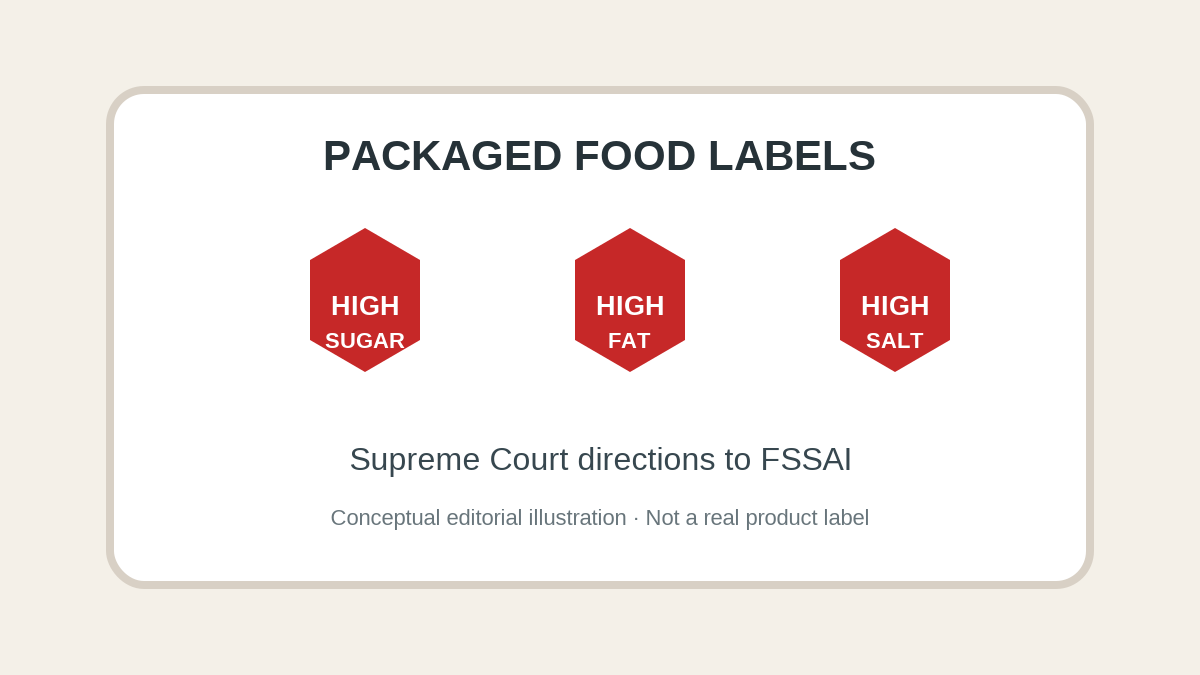
NEW DELHI, November 27, 2026 — The Supreme Court of India has directed the Food Safety and Standards Authority of India (FSSAI) to frame a front-of-package nutrition warning system that identifies packaged foods high in total sugars, saturated fat or salt. The order, delivered on November 26 in 3S and Our Health Society v. Union of India, requires separate red hexagonal warnings for each nutrient that crosses the final regulatory threshold.
The ruling does not mean the new labels must appear on every packet immediately. FSSAI must complete the regulatory process, revise nutrient thresholds and set out a transition plan. The Court accepted a 365-day transition period for food businesses after the regulations take effect, while warning against routine extensions and attempts to flood the market with unlabelled stock before the deadline.
What the Supreme Court has directed
The bench of Justices J.B. Pardiwala and K. Vinod Chandran said the nutrients of concern should be total sugars, saturated fat and salt. It rejected the use of “added sugar” and “added fat” as the central measures for this warning system. FSSAI must revisit the threshold values using evidence and avoid limits so low that almost every packaged food carries a warning or so high that products with substantial amounts escape scrutiny.
Each warning must be a separate hexagon, not one combined symbol for several nutrients. The symbol must include a standard pictorial representation and words such as “HIGH SUGAR”, “HIGH FAT” or “HIGH SALT”, as applicable. The label must be prominent and legible, and its size should be linked to the principal display panel of the package.
Why the Court rejected a combined warning
A separate symbol for each nutrient is intended to let a buyer see quickly whether a product crosses one threshold or several. A single combined label could hide that distinction. The Court also directed FSSAI to ensure that pictures accompany the warning words, so the message is not dependent only on a shopper’s ability to read the text.
The judgment is part of a case brought by 3S and Our Health Society seeking clearer front-of-pack nutrition information. Earlier regulatory discussions had considered a star-rating approach and other formats. The Court said a warning system must be useful at the point of purchase and must not be diluted into a label that leaves consumers to interpret a table of figures on the back of the packet.
What happens next for FSSAI and food companies?
FSSAI must reformulate the thresholds, specify label design and font size, and publish a reasoned list of food categories that may be exempt. It must also address how manufacturers could change recipes or use substitutes in ways that undermine the warning system. The Court asked the regulator to place a progress affidavit before it after ten weeks.
Food businesses will need to monitor the final regulations rather than assume that the judgment itself supplies every operational detail. The order leaves technical threshold-setting and the formal rule-making process with FSSAI. The one-year transition period begins under the framework described by the Court once the rules come into force; the judgment does not provide a calendar date on which all packs must change today.
What shoppers should understand
The warnings are designed to make nutrition risks easier to spot, not to declare that a food is unsafe in every serving or that a single nutrient label replaces the full nutrition panel. Shoppers should continue checking serving sizes, ingredients and the complete nutrition information. The new system is meant to add a quick, standardised signal on the front of the pack.
The Court also directed attention to practical nutrition education in schools and implementation of existing rules on foods sold or marketed around school premises. That part of the order connects package information with broader efforts to help children and families understand nutrition.
What is confirmed — and what is not yet final
- Confirmed by the judgment: separate pictorial hexagons for high sugar, high fat and high salt; nutrient focus on total sugars, saturated fat and salt; revised thresholds; and a 365-day transition period.
- Still to be finalised: the numerical nutrient thresholds, detailed technical specifications, exemption list and formal commencement date in the regulations.
- Not in force immediately: shoppers should not assume every current packet must already display the new warnings.
- Supreme Court judgment, 2026 INSC 1275 (PDF)
- The Indian Express: Supreme Court directions on food warning labels
- Reuters: Court tightens food-labelling proposal
Editorial note: This report is based on the Court’s judgment and independent reporting. The final thresholds and commencement date remain subject to FSSAI’s regulatory process.