Home / India News / Battery Manufacturing and Energy Storage
INDIA · ENERGY · MANUFACTURING · NOVEMBER 1322 Bids Received for India’s 10 GWh Grid-Scale Battery Manufacturing Tranche
The Ministry of Heavy Industries says 22 bids came in for 10 GWh of advanced chemistry cell capacity earmarked for grid-scale storage. Technical bids opened on November 11.
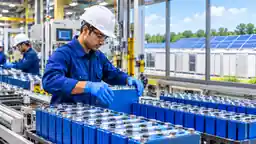
New Delhi, November 13, 2026: The Ministry of Heavy Industries has received 22 bids for incentives to establish 10 gigawatt-hours (GWh) of advanced chemistry cell (ACC) manufacturing capacity in India. The capacity is earmarked for grid-scale stationary storage, rather than being a direct allocation for electric-vehicle batteries. The ministry opened the technical bids on November 11, according to its statement reported by The Economic Times.
The milestone moves a long-running battery-manufacturing programme into another selection stage. It does not mean that 10 GWh of new cells have already been manufactured, that all 22 bidders will receive incentives, or that any plant has begun commercial production under this tender. The bids must still be evaluated under the scheme's selection process.
What the 10 GWh tender covers
The tender is part of the National Programme on Advanced Chemistry Cell Battery Storage, a production-linked incentive (PLI) scheme approved by the Union Cabinet in May 2021. The programme has a total budgetary outlay of ₹18,100 crore and a national manufacturing target of 50 GWh. A February 2026 government disclosure said 40 GWh had already been awarded to four beneficiary firms, leaving the latest 10 GWh tranche as a significant remaining allocation under the overall target.
The current tender is specifically for grid-scale stationary storage applications. These systems store electricity and release it when required, helping manage the gap between variable renewable generation and demand. They can support grid balancing and renewable integration, but their value depends on the cost, duration, location, operating performance and economics of the storage system.
Who submitted bids?
The Economic Times reported that the 22 bidders include Reliance Industries, Exide Energy Solutions, Amara Raja Advanced Cell Technologies, ACME Solar Holdings, JSW Neo Energy, Vikram Solar and Waaree Energy Storage Solutions, among others. The reported list also includes companies involved in renewable power, battery systems and related industrial activity.
The request for proposal was floated on July 15, 2026, and a pre-bid conference was held on July 29. The final date for bid submission was November 10. Technical bids were opened the following day in the presence of bidders, according to the ministry statement cited by the newspaper.
The ministry has described the selection as a two-stage Quality and Cost-Based Selection process. A bid count is therefore not a list of approved beneficiaries. Technical evaluation, compliance checks and the subsequent selection steps will determine which proposals can proceed.
Why grid-scale battery manufacturing matters
India's power system is adding solar and wind capacity, whose output changes with weather and time of day. Storage can absorb electricity when supply is abundant and discharge it when demand is higher or renewable output falls. The amount of storage required depends on the generation mix, transmission network, demand profile and the duration for which electricity must be shifted.
Domestic ACC manufacturing can also build capabilities in cell production, materials, quality control, pack integration and recycling. The government's stated objective is to encourage large-scale manufacturing and increase domestic value addition. The scheme is technology-agnostic, so the programme does not require every manufacturer to use one battery chemistry.
However, a production incentive alone cannot guarantee competitive battery costs. Manufacturers still need reliable raw-material supply, manufacturing yields, customer contracts, safety compliance, access to capital and a route to scale. Grid-scale storage projects also need viable tariffs and clear procurement arrangements from utilities or other buyers.
What happens after the bids?
The next public milestone should be the outcome of the technical and commercial evaluation. The November 12 reporting did not establish a final selection date or identify successful bidders. Companies should therefore not be described as PLI beneficiaries on the strength of this bid submission alone.
Readers should also distinguish manufacturing capacity measured in GWh from installed power measured in gigawatts (GW). GWh describes how much energy a battery system can store; GW describes how quickly it can deliver or absorb power. A 10 GWh manufacturing allocation does not by itself specify the number, location or operating duration of future grid-storage projects.
What to watch next
Important follow-up indicators include the list of technically qualified bidders, the final allocation, committed investment, plant commissioning milestones, actual cell output and the share of domestic value addition. The Ministry of Heavy Industries' scheme page and future PIB releases are the best places to check formal awards. Until those are published, the 22 bids should be treated as a competition stage, not a completed capacity addition.
Frequently asked questions
How many bids did the battery PLI tender receive?
The Ministry of Heavy Industries reported 22 bids for the 10 GWh grid-scale stationary storage tranche.
Does this mean 10 GWh of batteries are already being produced?
No. The bids were received and technical bids were opened. Selection, investment and manufacturing are separate steps that still have to take place.
What is the overall PLI ACC target?
The National Programme on Advanced Chemistry Cell Battery Storage has a target of 50 GWh and a budgetary outlay of ₹18,100 crore.
When were the technical bids opened?
The Economic Times reported that technical bids were opened on November 11, 2026, after the November 10 submission deadline.
- PIB: Ministry of Heavy Industries statement on 22 bids for 10 GWh ACC capacity (November 12, 2026)
- Ministry of Heavy Industries: PLI ACC scheme and official tender documents
- The Economic Times: 22 firms chase 10 GWh battery prize under PLI scheme, November 12, 2026
- Rediff/PTI: 22 bidders for 10 GWh battery storage PLI scheme, November 12, 2026
- PIB: Government disclosure on 40 GWh already awarded under the PLI ACC scheme, February 13, 2026
Editorial note: The 22-bid figure and tender milestones are attributed to the Ministry's statement and independent reporting. The article distinguishes bids from final awards and installed manufacturing capacity. The thumbnail is AI-generated conceptual artwork and does not depict a real bidder or factory.
Related coverage: India news · Rajasthan news · Education and jobs · Business and economy